Shaker, Slab or Raised Panel: Choosing a Cabinet Door Style
Cabinet doors are the most visible element of any kitchen. They're also one of the few decisions that's genuinely permanent — once installed, doors can't be easily changed without replacing or refacing the cabinets. The right door style ages gracefully for 20-30 years. The wrong door style starts to look dated within 5-10.
Three door styles dominate current kitchen design: Shaker, slab, and raised panel. Each has a different aesthetic profile, different cost, and different aging characteristics. Understanding what separates them helps avoid the most common kitchen design regret: choosing a door style that looked great when installed but reads as dated a decade later.
The Three Styles
Shaker Doors
Shaker doors are a five-piece construction: a frame (two stiles, two rails) surrounding a recessed flat center panel. The corners are typically mitered or doweled. The center panel sits inside grooves cut into the frame, allowing it to float with humidity changes [1].
The style originated with the Shaker religious community in the 19th century, valued for its simplicity and craftsmanship. It became dominant in residential kitchens during the early 2010s and remains the most popular kitchen cabinet door style in current design.
Aesthetic: Clean lines, balanced proportions, works in nearly any design context (modern, transitional, traditional, farmhouse, classic).
Cost in custom and semi-custom work: Mid-range. More labor than slab doors (the five-piece construction requires more cuts and joinery), but less than raised panel.
Aging characteristics: Excellent. Shaker has been in continuous use for two centuries. The proportions and details are time-tested. A Shaker door installed in 2010 looks essentially the same in 2025 as the day it was installed.
Best for: Any kitchen where versatility matters. Shaker reads as appropriate in modern minimalist kitchens, transitional kitchens with traditional elements, farmhouse aesthetics, and even some contemporary luxury work.
Slab Doors
Slab doors are flat-panel doors with no frame, no panel, no detail. A single piece of material — plywood with veneer, MDF with finish, or solid wood — produces a clean, uninterrupted face.
Aesthetic: Modern, contemporary, minimalist. The visual emphasis shifts to the wood grain, the finish, or the hardware rather than to the door's construction details.
Cost: Lowest of the three styles. The simplest to manufacture — fewer cuts, no joinery, simpler finishing.
Aging characteristics: Strong for genuinely modern kitchens, more questionable for kitchens with traditional elements. Slab doors paired with wood grain (walnut, white oak, rift-cut) age very well. Slab doors in painted finishes are more vulnerable to looking dated as paint colors fall out of favor.
Best for: Modern and contemporary kitchens, European-influenced design, kitchens where the wood species or finish is the visual focus. Particularly successful with rift-cut white oak, walnut, and other premium wood species where the grain itself provides visual interest.
Raised Panel Doors
Raised panel doors are also a five-piece construction, but the center panel has a profiled, raised surface — typically with shaped edges that create a frame-within-a-frame appearance. The profile can be subtle (cathedral, miter) or more pronounced (ogee, beveled).
Aesthetic: Traditional, formal, classical. The visual complexity reads as ornate compared to Shaker or slab.
Cost: Highest of the three styles. The shaped center panel requires more milling. Premium versions involve hand-finished detail work.
Aging characteristics: Best in genuinely traditional or classical kitchens. Raised panel doors paired with modern fixtures, finishes, and appliances can read as confused. Raised panel doors in formal traditional contexts (period homes, classical architecture) continue to read as appropriate.
Best for: Traditional kitchens in period homes, classical architecture contexts, formal entertaining spaces. Often paired with elements like crown molding, decorative valances, and inset construction.
The Inset vs. Overlay Question
This is a separate decision from door style but worth understanding because it affects both appearance and cost.
Full overlay: Doors and drawer fronts cover most of the cabinet face frame. Small gaps (1/8-inch typical) between adjacent doors. The current mainstream specification at semi-custom and above.
Partial overlay: Doors and drawer fronts cover part of the cabinet face frame, leaving the frame visible between doors. Older style, less common in current new construction.
Inset: Doors and drawer fronts sit flush within the cabinet face frame. The face frame surrounds each door visibly, producing a more traditional, more crafted appearance. Demanding to build correctly — the gap around each door must be perfectly even, requiring precise cabinet construction.
Inset construction adds 15-25 percent to cabinet cost over full overlay because the construction tolerance is tighter and the labor more skilled. Inset reads as higher-end and works particularly well with Shaker and raised panel doors. Slab doors are typically full overlay.
Color and Finish: The Decision That Dates Fastest
Door style itself ages reasonably well in any of the three categories. Door color and finish age very differently.
White and off-white painted: The default for the 2010s. Still appropriate but no longer dominant. Pure white kitchens can read as outdated in design contexts where warmer tones have become standard.
Gray painted: Dominated kitchen design from roughly 2015-2020. Now starting to read as that era's design choice. Gray kitchens installed in 2015 are at the point where homeowners are starting to consider updates.
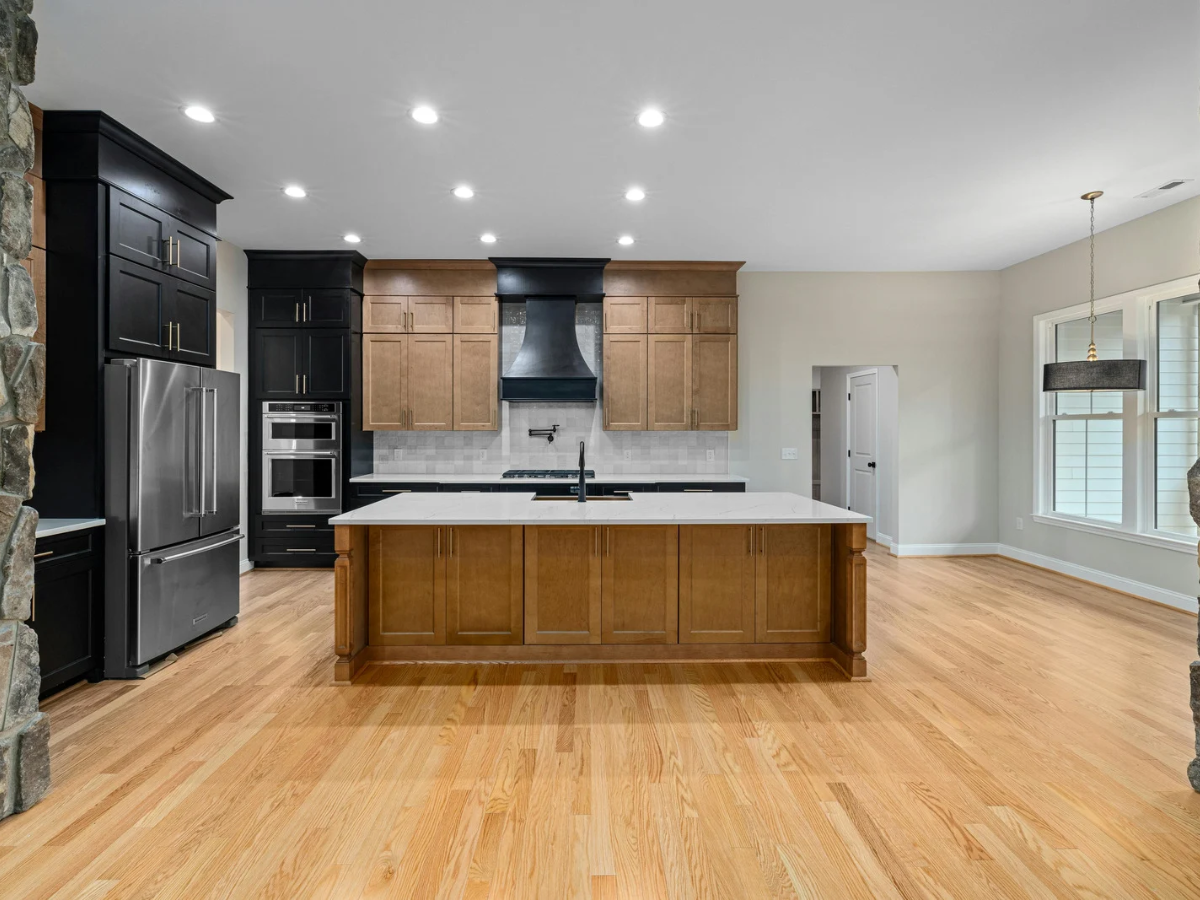
Two-tone (light uppers, dark lowers, or contrasting island): Popular currently. Has performed well aesthetically across multiple design cycles. Risk: very specific color combinations can date. A safe two-tone (white upper, navy or charcoal lower) ages well. A trend-of-the-moment combination ages faster.
Natural wood tones: Currently in resurgence after a decade of paint dominance. Walnut, rift-cut white oak, natural cherry, and unstained maple have all become popular specifications [2]. Natural wood ages slowly — the patina that develops over years is part of the appeal rather than damage.
Black or very dark painted: Increasingly popular in contemporary and modern work. The risk profile resembles the gray cabinet cycle of the mid-2010s — currently fashionable, possibly dating quickly. Particularly vulnerable in matte finishes that show wear at high-touch areas.
Specific colors (deep green, navy blue, burgundy, etc.): Most fashion-forward, most likely to date. A specific color choice that's currently popular often looks specifically of that era within 5-10 years.
The pattern: timeless choices (natural wood, white in classic contexts, deep neutrals) age slowly. Trend-forward choices (specific colors of the moment, finishes that feel fresh because they're new) age faster.
The Three Aging Paths
A useful way to think about cabinet door selection:
Path 1: Timeless and dateable to "quality construction"
White or off-white Shaker, natural wood tone slab in walnut or white oak, classic raised panel in cherry. These read as "well-made" rather than "of a specific era." The kitchen looks appropriate 20 years after installation because the choices weren't tied to a specific design moment.
Path 2: Of-the-moment but defensible
Two-tone Shaker in current colors, slab in current finish. These read as "of this era" but in ways that aren't likely to look terrible in 15 years. Some buyers will appreciate them; some will renovate them. Defensible if the homeowner accepts that aesthetic shifts will eventually come.
Path 3: Trend-forward and likely to date
Distinctive colors, specific finishes that read as fashion choices, decorative details that are currently fashionable but historically transient. These age the fastest. Worth choosing only if the homeowner specifically wants the current look and will renovate again before it ages out.
The path isn't determined by the door style alone. A Shaker door in a fashion color can be path 3; a slab door in walnut can be path 1. The combination of style, color, and finish determines aging.
What Houzz and NKBA Data Show
Current trend data from the 2025 Houzz Bathroom and Kitchen Trends Study shows specific patterns [2][3]:
- Wood-faced cabinets are at 62 percent of upgrades, the dominant material choice
- Shaker doors continue to dominate at the door style level
- Warm wood tones are gaining against cool grays and stark whites
- Mixed-metal hardware is increasingly the norm rather than matching everything
The aggregate picture: kitchens are moving toward warmer, more natural materials. The all-white, gray-and-white, or stark-modern kitchens that dominated the 2010s are giving ground to wood-toned cabinets, two-tone combinations, and design that reads as warmer.
For homeowners planning a renovation in 2026, this matters. A kitchen that's specified to current 2026 sensibilities (warmer wood tones, natural materials, Shaker proportions) will age more gracefully than a kitchen specified to 2018 sensibilities (all-white, cool gray, ultra-modern). The trend toward warm is itself part of a longer cycle, but it's the cycle that's currently ascendant.
Practical Selection Approach
A reliable sequence for choosing cabinet door style:
Start with the overall design direction. Modern minimalist? Slab. Transitional or classic? Shaker. Traditional or formal? Raised panel. These pairings reduce errors substantially.
Consider how long you'll be in the home. Renovating for short-term ownership (under 5 years)? Stay closer to current trends; resale value is more sensitive to "feels current." Renovating for long-term ownership (10+ years)? Choose timeless over trendy.
Sample the actual door in context. Door samples should be evaluated in the kitchen, against the actual lighting, with samples of the proposed cabinet color, paired with proposed countertop samples. Showroom evaluation is less reliable than home evaluation.
Consider hardware compatibility. Door style and hardware should coordinate. Slab doors typically work with simple bar pulls or finger pulls. Shaker doors work with a wide range of hardware from minimal to traditional. Raised panel doors typically pair with traditional hardware (cup pulls, classical knobs).
Don't try to be too clever. A standard Shaker door in a quality finish is a more reliable specification than an unusual door style that the homeowner saw in a magazine and decided to try.
The Bottom Line
Door style is one of the more visible kitchen renovation decisions and one of the harder to change after installation. Choosing thoughtfully — with attention to aging characteristics, color durability, and compatibility with the overall design direction — produces kitchens that look appropriate for two decades.
The reliable pattern: Shaker for almost any kitchen, slab for genuinely modern work, raised panel for traditional and formal contexts. Combined with timeless finishes (natural wood, classic whites, deep neutrals), these choices age well.
The fashion-forward approach is fine for homeowners who accept that fashion changes. The trade-off is real, and it's worth deciding which side of it to take deliberately.
For the full discussion of cabinet tiers, construction quality, hardware, and interior organization, see the cabinetry pillar guide.
Sources:
[1] Custom Kitchen Cabinets — Door Style Comparison — https://custom-kitchen-cabinets.com/resources/cost-planning-guides/how-much-do-custom-kitchen-cabinets-cost/ [2] Modern Bathroom — 2026 Bathroom and Kitchen Trends — https://www.modernbathroom.com/blogs/bathroom-buying-guides/2026-bathroom-ideas-and-trends-youll-want-to-copy [3] Sweeten — 8 Bathroom and Kitchen Design Ideas Worth the Spend in 2026 — https://sweeten.com/ideas-and-inspiration/popular-bathroom-design-ideas/
Related Posts
Soft-Close Hinges and Full-Extension Slides: Hardware That Lasts
Soft-close hinges, full-extension slides and the weight ratings behind them — the specifications that decide how a Columbus kitchen behaves in year ten.
Plywood vs Particleboard vs MDF: Why the Cabinet Box Matters
When most homeowners think about cabinets, they think about the doors — the visible faces, the style, the color, the finish. The doors get most of the attention because they're what shows.
Inside Your Cabinets: 12 Interior Specs Worth Adding Up Front
Cabinet boxes are containers. What's inside them determines how usable the kitchen actually is. A kitchen with beautiful cabinetry and no interior organization produces piles on the counter, cookwa...