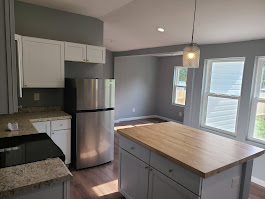
Galley, U-Shaped, L-Shaped or Island: Which Kitchen Layout?
Four layouts cover almost every Columbus kitchen: galley, L-shaped, U-shaped and peninsula. The room usually decides which one is possible, and the choice moves the price less than most people expect. On a 10-by-10 remodel the estimator on this site prices a galley or an L at $31,956 and a U or a peninsula at $33,516.
Reviewed September 2026 by a licensed Ohio general contractor.
What Actually Separates the Four Layouts
A kitchen layout is a description of how many walls carry cabinetry and how the cook moves between the sink, the cooktop and the refrigerator. Two runs facing each other is a galley. Two runs meeting at a corner is an L. Three connected runs is a U. A U with one leg pulled away from the wall so it can be walked around on three sides is a peninsula.
Everything else — island, seating, pantry, appliance placement — is something added to one of those four shapes, not a fifth shape.
Galley
A galley kitchen puts two parallel runs of cabinetry on facing walls with one aisle between them. It is the most efficient shape per square foot and the one that suffers most from a bad aisle dimension.
Works when: the room is a corridor, the house is a condo, a townhouse or a pre-war double, and the kitchen is not the room people gather in.
Strengths: everything is within a step or two. Counter runs are uninterrupted by corners, which makes them cheaper to fabricate and easier to work on. Cabinet quantities are predictable.
Watch for: aisle width. NKBA planning guidelines put a one-cook work aisle at 42 inches and a two-cook aisle at 48. Below that the kitchen works but doors start colliding — a dishwasher door and an open oven door facing each other need the room. The clearance list every Columbus kitchen plan should pass goes through the dimensions one at a time.
L-Shaped
An L-shaped kitchen runs cabinetry along two walls that meet at a corner and leaves the rest of the room open. It is the most common layout in post-war Columbus housing and the most forgiving to remodel.
Works when: the kitchen shares space with a dining area or an open plan, and the room has one usable corner.
Strengths: traffic passes through the open side instead of through the work zone. It takes an island without crowding. It keeps the work triangle compact with only two legs against walls.
Watch for: the corner. A blind corner base cabinet swallows storage unless it gets a corner solution, and corner solutions are a cabinet upgrade, not a free feature. On long legs the walking distance between the refrigerator and the range grows quickly.
U-Shaped
A U-shaped kitchen wraps three connected walls. It gives the most counter and the most storage per square foot of floor, and it needs the most room to avoid feeling like a closet.
Works when: the room is close to square, at least about eight feet between the legs, and the household cooks seriously.
Strengths: the longest continuous counter of any layout. Two corners means two upper runs, so wall storage is generous. Traffic has no reason to cross the work zone because there is only one way in.
Watch for: two corners instead of one, which means two corner cabinets and more cut counter. It costs more than an L for the same footprint: on a 10-by-10 the estimator puts a U at $33,516 against $31,956 for an L, a difference of $1,560 on the subtotal.
Peninsula
A peninsula is a U whose third leg is attached at one end and open on the other three sides. It is what an island becomes when the room cannot give up clearance on all four sides.
Works when: a full island will not fit but the household wants seating and a visual break between the kitchen and the next room.
Strengths: seating and counter without the four-sided clearance an island demands. The attached end can carry plumbing or a circuit far more cheaply than an island can, because the run does not have to cross open floor.
Watch for: the corner where the peninsula meets the run, and the traffic pinch at the open end. In the estimator a peninsula prices exactly as a U does, because structurally it is a U with a passthrough.
An Island Is Not a Layout
A kitchen island is something added to an L or a U. In the estimator it is a toggle rather than a layout, and it adds three things at once: more cabinetry, more counter, and a dedicated circuit. Put a sink or a cooktop in it and plumbing or ventilation follows the circuit under the floor.
The clearance rule decides whether it fits at all — 42 to 48 inches of clear aisle on every side that gets used. A room that cannot give that up is a peninsula room. How much room a kitchen island actually needs works through the minimums.
What This Means for Your Budget
Layout moves the number less than size, appliance grade or counter material do. These are the 10-by-10 and 12-by-14 subtotals from the estimator on this site, with stone counters, reusable circuits, rough plumbing included and no appliance line:
| Layout | Standard (10' × 10') | Large (12' × 14') |
|---|---|---|
| Galley | $31,956 ($31,056–$32,856) | $38,784 ($37,884–$39,684) |
| Basic L | $31,956 ($31,056–$32,856) | $38,784 ($37,884–$39,684) |
| U-Shape | $33,516 ($32,616–$34,416) | $41,904 ($41,004–$42,804) |
| Peninsula | $33,516 ($32,616–$34,416) | $41,904 ($41,004–$42,804) |
Going from a 10-by-10 to a 12-by-14 costs more than going from an L to a U, and adding a mid-grade appliance package costs more than either. See kitchen remodel cost in Columbus for how those lines are built, price your own combination in the kitchen cost estimator, or start at how Columbus kitchen pricing works.
The Room Usually Decides
Most Columbus kitchens are not a free choice between four layouts. A corridor between a back door and a dining room is a galley. A square room off a hallway with one window wall is an L or a U. What is genuinely open is where the sink and the range sit inside the shape, and that is the decision worth spending design time on.
The three things to measure before any of this is settled: the distance between opposing runs, the width of every doorway into the room, and where the plumbing stack and the panel are. The first two decide whether a layout is legal to build. The third decides what it costs.
Two Cooks in One Kitchen
Layouts behave differently when more than one person is working. A galley with a 48-inch aisle handles two cooks well as long as they are not reaching into the same run. An L handles two cooks poorly at the corner and well everywhere else. A U is the best of the four for two cooks, because each leg can be its own zone. A peninsula gives a second person somewhere to stand that is not in the work path.
If two people cook together regularly, that is worth more than any aesthetic preference between the shapes.
Changing From One Layout to Another
Converting a galley into an L, or an L into a U, means removing or adding a run of cabinetry — and that usually means the sink, the range or both end up somewhere new. That is where the cost lands, not in the shape itself. What it costs to move a kitchen sink, range or refrigerator covers what each relocation pulls in.
Removing a wall to open a galley into the next room is a separate project with its own price, and the estimator carries it as a standalone structural line rather than as part of the kitchen.
How to Choose
- Galley when the room is a corridor and the aisle can hold 42 inches or more.
- L-shaped when the kitchen opens onto another room and traffic has to pass through.
- U-shaped when the room is close to square, at least eight feet between legs, and the household cooks often.
- Peninsula when seating and a room divider matter more than walking around all four sides.
- Add an island only after the 42-to-48-inch clearance on every used side is confirmed on the plan.
Settle the shape against the room's real dimensions first. Cabinet doors, appliance selections and finishes are decisions that can change later; a layout that does not fit the room is a decision that cannot.
Questions & answers
- Which kitchen layout is cheapest to remodel?
- A galley or an L-shaped kitchen. On a 10-by-10 remodel with stone counters and reusable circuits, the estimator on this site prices both at $31,956, against $33,516 for a U-shape or a peninsula. The $1,560 difference is the second corner: another corner cabinet and more cut countertop.
- How much room does a U-shaped kitchen need?
- About eight feet between the legs is the practical minimum. Below that the two facing runs squeeze the work aisle, and NKBA planning guidelines put a one-cook aisle at 42 inches and a two-cook aisle at 48. A room that cannot give up that width is an L-shaped or galley room, not a U.
- Is a peninsula the same as a kitchen island?
- No. A peninsula is attached to the cabinet run or a wall at one end and open on the other three sides; an island is free on all four. That attachment is why a peninsula can carry plumbing or a circuit far more cheaply, and why it fits rooms that cannot give up 42 to 48 inches of clearance on every side.
- Can a galley kitchen be converted to an L-shape?
- Usually, but the cost is not in the shape. Converting means removing or adding a run of cabinetry, which normally puts the sink, the range or both in a new place, and relocation is what moves the number. Opening a galley into the next room by removing a wall is a separate structural line on top of the kitchen.
- Which kitchen layout works best for two cooks?
- A U-shape, because each leg becomes its own zone and nobody has to cross the other. A galley handles two cooks well if the aisle is 48 inches. An L handles them poorly at the corner and well everywhere else. A peninsula gives a second person somewhere to work that is out of the main path.
- Does kitchen size matter more than layout for the cost?
- Yes, by a wide margin. Going from a 10-by-10 to a 12-by-14 adds 44 in-house man-hours and a second counter slab, which takes an L-shaped remodel from $31,956 to $38,784 in the estimator on this site. Changing the layout at the same size moves it by $1,560.