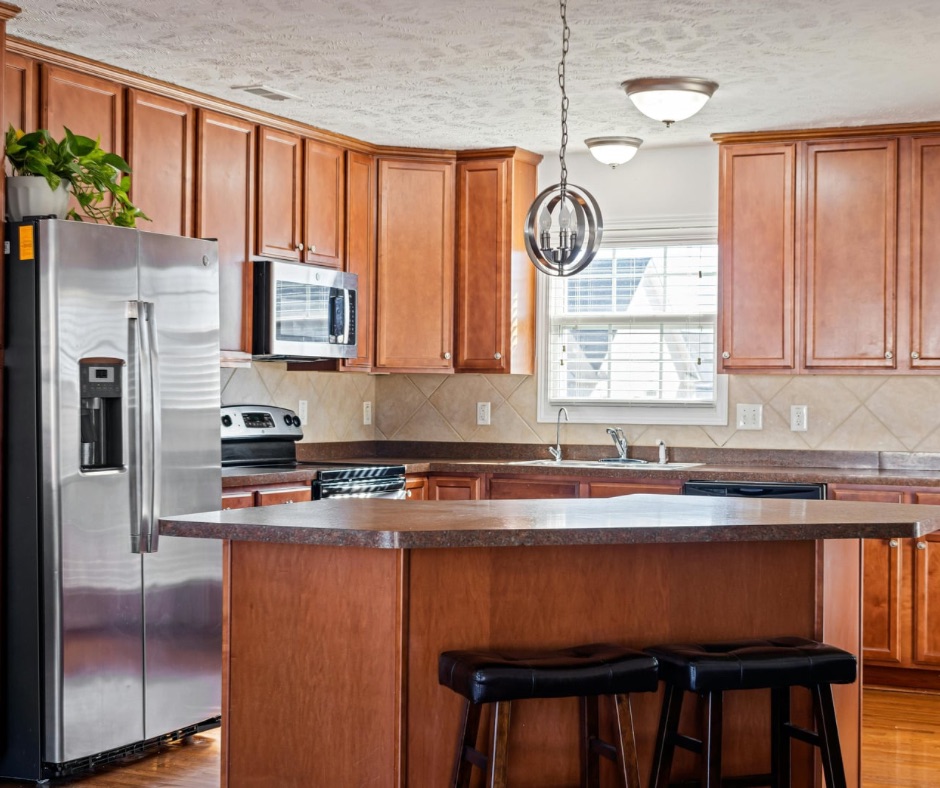
Cabinet Refacing vs. Replacing Cabinets in a Columbus Kitchen
Refacing keeps the existing cabinet boxes and replaces the doors, drawer fronts, visible veneer and hardware. Replacement takes everything out and starts again, which is what makes a new layout possible. Refacing costs less and changes less. The choice comes down to three things: whether the boxes are sound, whether the layout works, and how long you are staying in the house.
Reviewed September 2026 by a licensed Ohio general contractor.
The two paths differ in scope, in disruption, and in what they can fix, and neither is the right default. Cabinet refacing is also not something the estimator on this site prices — the tool prices a full gut remodel, with cabinets as one line inside it. So what follows is the decision rather than a refacing quote: what each path includes, what refacing cannot fix, and the engine-priced numbers on the replacement side.
What Refacing Actually Is
Cabinet refacing keeps the existing cabinet boxes in place and replaces the visible surfaces:
- New doors and drawer fronts
- New veneer or laminate applied to visible box faces
- New hardware (hinges, pulls, knobs)
- New drawer slides (typically)
- Sometimes new interior shelves or modifications
The cabinet structure — the boxes themselves, the layout, the configuration — stays exactly as it was. The kitchen looks completely different from the front because everything visible is new. From inside the cabinets, it's the same kitchen.
Refacing is quoted by the companies that specialise in it, and the number moves with door style, material, and how many doors and drawer fronts the kitchen has. The estimator on this site does not price it, so no Columbus refacing figure is published here. Get at least two quotes itemised by door and drawer count, and ask specifically what is being done to the visible box faces.
What Replacement Actually Is
Cabinet replacement removes the existing cabinets entirely and installs new ones. Everything is new — boxes, doors, drawers, interior organization, hardware. The layout can change. Cabinet sizes can change. Heights, depths, and configurations are all flexible.
Replacement also opens up everything behind and around the cabinets. New cabinets typically come with new layout possibilities, which means the project can involve new plumbing rough-in locations, new electrical, new lighting, and adjacent finishing work (drywall, paint, flooring).
On the replacement side there are engine-priced Columbus numbers. A full gut remodel of a 10-by-10 kitchen — Basic L layout, stone counters, reusable circuits, rough plumbing included, no appliance package — comes to $31,956 in the estimator on this site, with a cabinet-grade range of $31,056 to $32,856. The cabinetry inside that total is a single line at $3,250, with a band of $2,500 to $4,000.
When Refacing Is the Right Call
Refacing makes sense when several conditions line up:
The Existing Boxes Are Sound
Refacing works on the existing cabinet structure. If the boxes are particleboard from the 1990s, swollen at corners, with hinges loose and shelves sagging, refacing puts a beautiful face on a failing structure. The new doors will outlast the boxes they're mounted on.
Refacing is appropriate when the existing boxes are plywood or solid wood, structurally sound, and have at least another 10–15 years of life in them. For most well-built 1990s and 2000s cabinets, this is true. For builder-grade 1970s-80s particleboard cabinets, often not.
A simple test: open and close drawers and doors. If they feel solid, latch correctly, and don't show structural compromise, the boxes are probably worth keeping. If drawers rack, doors don't align, or boxes feel flexible, replacement is the better path.
The Existing Layout Works
Refacing keeps the existing layout exactly. If the current layout has good flow, adequate counter space, working triangles within NKBA dimensions, and adequate storage — and the only complaint is appearance — refacing addresses the actual problem at a fraction of the cost.
If the existing layout has functional problems (cramped work aisles, no landing area, the dishwasher on the wrong side of the sink), refacing won't fix any of those. The kitchen will look new and still function poorly.
The Budget Drives the Decision
Refacing's primary advantage is cost, and the gap is large: new fronts and hardware on sound boxes is a fraction of what taking a kitchen back to the studs costs. For households where budget is the binding constraint — a house being prepared for sale, a rental, a secondary kitchen, or a short expected stay — refacing produces more visible improvement per dollar than replacement does.
The Cost vs. Value Report places minor kitchen remodels — the category refacing usually falls into — among the highest-returning interior projects at resale [1]. The site's own cost versus value breakdown for Columbus puts those percentages next to local dollars.
The Aesthetic Goal Is Refresh, Not Transformation
Refacing produces a refreshed kitchen — same room, new face. Replacement can produce a transformed kitchen — new layout, new feel, new capabilities. The aesthetic outcomes are different in kind, not just degree.
If the goal is "this kitchen looks dated and needs to look current," refacing usually achieves it. If the goal is "we want a different kitchen," refacing won't get there.
When Replacement Is the Right Call
Replacement is the right answer when:
The Existing Boxes Aren't Worth Keeping
Particleboard boxes past their service life. Construction quality that doesn't merit the refacing investment. Hardware that has failed and won't be effectively reset. If the boxes won't last another 15 years, refacing puts good money after bad — the new doors will outlive the structure underneath.
The Layout Needs to Change
Adding an island. Removing a peninsula. Moving the sink from one wall to another. Creating a walk-in pantry from former closet space. Extending the kitchen into an adjacent room. Any meaningful layout change requires new cabinetry.
Storage Needs Are Fundamentally Different
Modern kitchens often need different storage than 1980s and 1990s designs assumed. Deep drawer banks instead of base cabinet shelves. Pull-out trash and recycling. Built-in spice racks. Integrated outlets. Specialty appliance garages. Most of these features require new cabinets — they can't be retrofitted into existing boxes effectively.
Long-Term Ownership Justifies the Investment
For homeowners staying in the home 15+ years, the math shifts. Refacing costs less up front but produces a kitchen that looks 15 years older than it should because the layout and storage haven't evolved. Replacement costs more but produces a kitchen that fits the household's actual needs and lasts the full life of ownership.
The Rest of the Kitchen Is Being Renovated
If the project also involves new flooring, new appliances, new countertops, new lighting, and new paint, the marginal cost of replacing cabinets while everything else is open is smaller than it appears. Doing everything but the cabinets means redoing them later — at which point all the surrounding work gets disturbed.
What Refacing Doesn't Address
Refacing is a real option with real limits. Some things it doesn't solve:
Storage layout. If the current cabinets have shelves where you want drawers, refacing won't change that. (Some refacing companies offer "drawer conversion" but this is essentially replacing the lower cabinet — at which point it's hybrid refacing/replacement.)
Cabinet height and depth. Refacing keeps the existing dimensions. Standard older cabinets are 36 inches tall with a soffit above; modern cabinets often run to the ceiling. Refacing won't add the upper cabinets.
Cabinet quality upgrades. Refacing puts new doors on existing boxes. It doesn't upgrade the box construction, the drawer joinery, or the hardware quality (beyond what's specified for the reface itself).
Layout changes. Adding cabinets where none existed. Removing cabinets to open a wall. Reconfiguring the work triangle. Refacing keeps everything where it is.
For homeowners where these limitations matter, replacement is the only path.
What the Estimator on This Site Prices
The tool on this site prices a gut remodel, not a refresh. That matters for this decision, because it means the replacement path has a published Columbus number and the refacing path does not. On a 10-by-10 Basic L kitchen with stone counters, reusable circuits and rough plumbing included, the lines look like this:
| Cost line | Amount |
|---|---|
| Labor — 148 in-house man-hours at $85 | $12,580 |
| Management — 10 days, 2 hours each at $155 | $3,100 |
| Plumbing sub | $1,500 |
| Electrical sub | $1,500 |
| Install material | $2,750 |
| Cabinets | $3,250 |
| Countertop (stone) | $1,950 |
| Bucket, before contingency | $26,630 |
| × 1.20 construction contingency | $31,956 |
Two things in that table are worth sitting with. The cabinetry line is $3,250 — a little over a tenth of the total, not the 30 to 40 percent that gets repeated about kitchen budgets. And labor is $12,580, roughly four times the cabinet line. That is the honest shape of a replacement project: the boxes are not what makes it expensive. Taking a kitchen apart and putting it back together is.
It also explains where refacing actually saves. Refacing does not demolish, does not open walls or floors, does not trigger rough plumbing or new circuits, and does not need drywall, paint and floor patching afterward. It skips most of the labor line, which is the largest line in the table. That is the saving — not a cheaper cabinet.
The Honest Trade-Off
Refacing produces a kitchen that looks markedly better than it did, at a fraction of replacement cost, on a shorter timeline. It also produces a kitchen with the same layout, the same storage limitations, and the same construction quality as the original.
Replacement produces a kitchen that's fundamentally new — new layout possibilities, new storage solutions, new construction quality. It also costs roughly 2–3x more, takes longer, and involves more disruption.
Neither is "better." Each fits a different project goal.
The wrong choice in either direction is the more expensive mistake. Replacing perfectly sound 5-year-old cabinets because "I wanted everything new" is overspending on a problem that didn't exist. Refacing 1980s particleboard cabinets because "the budget is tight" produces a kitchen that fails within a decade and costs more to fully redo than honest replacement would have.
How to Decide
A practical decision framework:
- Are the existing boxes structurally sound? If no, replacement is the path.
- Does the layout work? If no, replacement is the path.
- Is the budget the binding constraint, and the existing kitchen functionally adequate? If yes, refacing is the path.
- Will you live in this home long-term, and does the kitchen need to evolve with the household? If yes, replacement is usually the path.
If steps 1 and 2 do not disqualify refacing and steps 3 or 4 favor it, refacing produces more value per dollar than most homeowners assume.
The Bottom Line
Cabinet refacing is an underused option in Columbus kitchens. It is not the right answer for every kitchen — but for the kitchens it fits, it produces a changed appearance at a fraction of the cost and time of full replacement.
The contractors who push replacement on every project don't always do so dishonestly — replacement is often a better fit and certainly a larger project for them. But for homeowners trying to make the best decision for their specific kitchen, asking specifically about refacing is worth doing. The answer may be that the existing cabinets can't support it. The answer may be that the layout needs to change. Or the answer may be that refacing is the right call — and the kitchen costs half what the homeowner thought it would.
For how every line in a Columbus kitchen budget is built, see kitchen remodel cost in Columbus. To price a replacement against your own layout and conditions, use the kitchen cost estimator, or start at how Columbus kitchen pricing works. If the boxes are the open question, what cabinet boxes are actually made of covers how to tell plywood from particleboard in the kitchen you already have.
Sources
Questions & answers
- Is cabinet refacing cheaper than replacing cabinets?
- Yes, and the saving is mostly labor rather than materials. Refacing leaves the boxes and the layout alone, so there is no demolition, no rough plumbing, no new circuits, and no drywall, paint or floor patching afterward. In the estimator on this site, labor is $12,580 of a $31,956 gut remodel on a 10-by-10 kitchen, and that is the line refacing largely skips.
- Can particleboard cabinets be refaced?
- They can, but it is usually a poor investment. Refacing mounts new doors and hardware on the existing boxes, so boxes that are swollen at the corners, sagging at the shelves, or loose at the hinge screws will fail before the new fronts do. Plywood or solid wood boxes that still feel rigid are the ones worth refacing.
- Does refacing change the kitchen layout?
- No. Refacing keeps every cabinet where it is, at its existing size, height and depth. Adding an island, removing a peninsula, moving the sink, converting shelves to drawers, or running cabinets to the ceiling all need new cabinetry. If the complaint about the kitchen is how it works rather than how it looks, refacing will not fix it.
- How long does cabinet refacing take compared with replacement?
- Refacing is a short job because the destructive stages are skipped — days rather than the weeks a gut remodel needs. For comparison, the estimator on this site schedules 10 working days of in-house crew time for a standard kitchen, and the full on-site sequence runs about 13 to 14 working days once subs and inspections are counted.
- Does the estimator on this site price cabinet refacing?
- No. The tool prices a full gut remodel, with cabinets as a single line at $3,250 and a cabinet-grade band of $2,500 to $4,000. Refacing is quoted by the companies that specialise in it, priced by door and drawer count, door style and material. Get two itemised quotes and compare what each one does to the visible box faces.
- Is refacing worth it before selling a house?
- Often, yes. A house being prepared for sale wants visible improvement per dollar, which is what refacing produces when the layout already works and the boxes are sound. If the kitchen has a functional problem a buyer will notice — no landing counter beside the range, a cramped aisle, a dishwasher on the wrong side of the sink — refacing leaves that problem in place.