What a $50K Columbus Kitchen Remodel Actually Includes
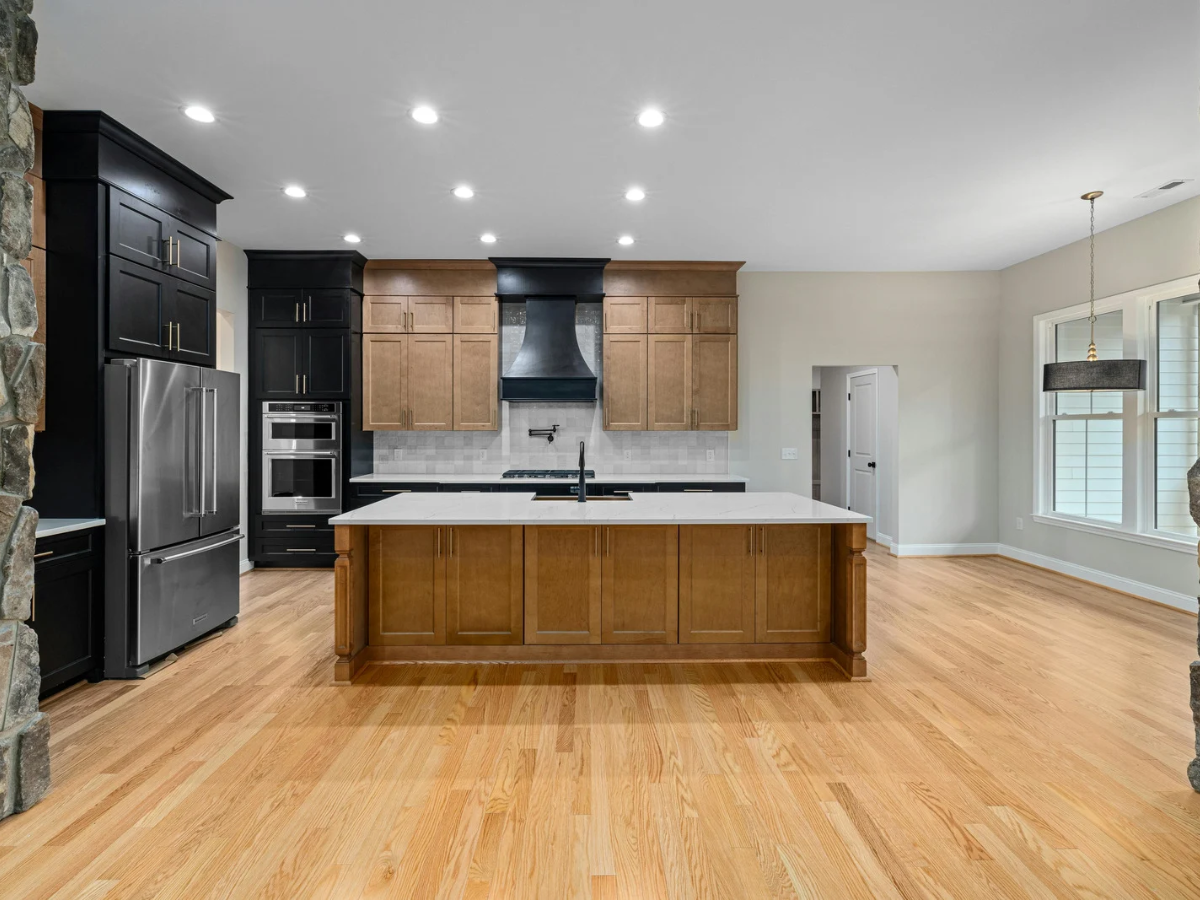
Fifty thousand dollars buys a full gut remodel of a standard Columbus kitchen with mid-grade appliances, or a larger kitchen without them, or a standard kitchen with one piece of structural work. The estimator on this site prices those three shapes at $48,992, $51,994 and $53,094. What follows is where every dollar in that number goes.
Reviewed September 2026 by a licensed Ohio general contractor.
A $50,000 Kitchen Is Not One Kitchen
There is no single $50,000 scope. There are combinations of size, layout, appliance grade and existing conditions, and several of them land within a few thousand dollars of that figure. Three of them, from the estimator on this site:
- A large kitchen, mid appliances. 12-by-14, U-shape or peninsula, stone counters, reusable circuits, rough plumbing included, mid-grade appliance package: $48,992, cabinet-grade range $48,092 to $49,892.
- A standard kitchen, high-grade appliances. 10-by-10, L or galley, stone counters, high-grade appliance package: $51,994, range $51,094 to $52,894.
- A standard kitchen, mid appliances, one wall removed. 10-by-10 L, stone counters, mid appliances, plus taking out a load-bearing wall with a steel beam over a 14-foot span: $53,094, range $52,194 to $53,994.
The same budget therefore buys square footage, appliance grade or structural change — one of the three, not all of them. That is the first useful thing to know before a design is drawn.
The Line-by-Line Anatomy
Here is the third combination above, broken into the lines the estimator actually builds. The order matters, because not everything sits inside the contingency.
| Cost line | Amount |
|---|---|
| Labor — 148 in-house man-hours at $85 | $12,580 |
| Management — 10 management and inspection days, 2 hours each at $155 | $3,100 |
| Plumbing sub | $1,500 |
| Electrical sub | $1,500 |
| Install material | $2,750 |
| Cabinets | $3,250 |
| Countertop (stone) | $1,950 |
| Bucket, before contingency | $26,630 |
| × 1.20 construction contingency | $31,956 |
| Mid-grade appliance package (rides on top) | $7,088 |
| Load-bearing wall and steel beam (rides on top) | $14,050 |
| Subtotal | $53,094 |
Labor — $12,580
This is the largest single line in the project, and it is the one most homeowners underestimate. It is 148 in-house man-hours at $85 an hour: demolition, framing, insulation, drywall hang and finish, priming and painting, cabinet installation, trim and finish carpentry, backsplash and the final clean.
The hours come from a schedule, not from a percentage of the material cost. One working day is a two-person crew for eight hours, so 148 hours is ten crew days on a standard kitchen. A 12-by-14 runs 192 hours, which is twelve.
Management — $3,100
Ten management and inspection days, billed at two hours a day. This is the coordination that keeps the trades in the right order: letting the plumber in, walking the electrician through the cabinet plan, meeting the inspector, scheduling the counter template after the cabinets are set and before the backsplash starts.
It is a real line rather than overhead because a kitchen has more sequencing dependencies than almost any other room. Getting the order wrong costs more than the coordination does.
Plumbing and Electrical Subs — $1,500 Each
The plumbing line is $1,500 when rough plumbing is required, which is the case whenever the sink moves or the existing pipe is old enough that it is coming out. When the sink stays and the pipe is sound, only finish plumbing is performed and the line is $500.
The electrical line is $1,500 when the existing kitchen circuits can be reused. Isolating the kitchen and pulling new runs takes it to $3,500. If the panel has to be replaced to carry the load, it goes to $6,000 — a common finding in pre-1980 inner-ring houses. What it costs to move a kitchen sink, range or refrigerator works through which conditions get triggered by which moves.
Install Material — $2,750
A fixed lump that covers what the crew consumes rather than what the homeowner picks: demolition supplies, the dumpster, framing lumber, drywall, drywall finishing materials, paint, finish carpentry materials and the miscellaneous hardware a job burns through.
It does not cover tile, fixtures, faucets or flooring. Those are selections, and they are commonly supplied by the homeowner rather than bought by the contractor. Cabinets and the countertop have their own lines.
Cabinets — $3,250
One line, at a representative mid-grade cost, with a band of $2,500 to $4,000 either side. That band is where the cabinet-grade range under every headline figure comes from: recompute the whole project at $2,500 and at $4,000 and nothing else changes.
Cabinets are worth noticing for a different reason. They are the longest-lead item in the project, so the cabinet decision sits at the front of the schedule even though the installation is near the end. How far in advance cabinets have to be ordered covers what that does to the calendar.
Countertop — $1,950
Stone slab on a standard 10-by-10, priced at material cost plus the sub markup that applies to fabricated stone. Laminate is the other option the estimator prices: stock preformed sections come in at $400 on the same 10-by-10, and custom-made laminate at $900 on a 12-by-14. Quartz, solid surface, butcher block, tile and bespoke tops are not estimated at all.
The 1.20 Contingency
Everything above is added together into a bucket and multiplied by 1.20. On this kitchen that turns $26,630 into $31,956.
This is the line homeowners push back on hardest and the one that protects them most. A remodel opens walls and floors in a house built decades ago under different practices. Rot around a window, a drain that was never vented correctly, knob-and-tube in a ceiling bay, a floor that is out of level by an inch across the room — these are found on demolition day, not on the walkthrough. A project without that allowance is a project that turns every finding into an argument.
Appliances — $7,088 at Mid Grade
The appliance package rides on top of the contingency at its own markup, not inside the bucket, and it is shown at typical all-in cost. Who actually buys the appliances does not change the project cost.
The grade is the biggest single swing in the whole model. On the same 10-by-10 kitchen, an economy package adds $3,180, mid adds $7,088, high adds $20,038 and luxury adds $76,044. Nothing else in a kitchen moves the total that far that fast.
Structural Work — $14,050
Removing a load-bearing wall with a steel beam over a 14-foot span, priced as its own standalone line on top of everything else. It is the line that turns a $39,000 kitchen into a $53,000 one.
Opening a galley into the next room is the most common reason it appears. It is also the line most likely to be missing from a quote that was written before anyone checked whether the wall was carrying anything.
What $50,000 Does Not Include
- Permits and inspection fees, which are paid to the municipality
- HVAC duct relocation and range-hood makeup air
- Main-stack rebuild, unless it is added as a condition
- Electrical panel replacement, unless it is added as a condition
- Unforeseen conditions found on demolition, which are handled as change orders before work continues
- Quartz, solid surface, butcher block, tile and bespoke countertops
- Kitchenettes, single-wall kitchens, partial or cosmetic remodels and non-standard layouts, which are quoted individually
What Pushes a Kitchen Past $50,000
Four things, in order of how much they move the number: a high-grade or luxury appliance package; structural work; a panel replacement plus isolated circuits; and size, because a 12-by-14 adds 44 man-hours and a second counter slab before anything else changes.
A 10-by-10 U-shape with high-grade appliances, an island and isolated electrical reaches $57,514. A 12-by-14 peninsula with luxury appliances, an island, isolated circuits and a new panel reaches $124,908. The appliance grade is doing most of that work.
What Brings It Under
The same levers run the other way. A 10-by-10 galley with no appliance line, stock preformed laminate counters and the sink staying where it is — so rough plumbing is skipped — comes to $28,356, with a cabinet-grade range of $27,456 to $29,256.
That is the same crew, the same schedule and the same contingency. The difference is three decisions: skip the appliance package, change the counter material, and leave the plumbing alone.
How Long It Takes
The in-house crew time is ten working days on a standard kitchen and twelve on a large one. The full on-site schedule runs longer than the crew days, because the subs and the inspections sit between them: demolition, framing, electrical rough, plumbing rough with HVAC alongside it, insulation, drywall hang, drywall finish, prime and paint, cabinets and trim, counters, backsplash, grout, appliances, then clean-up and touch-up. In practice that is about 13 to 14 working days, or roughly three weeks on site.
Permits
Columbus Department of Building and Zoning Services requires a permit when plumbing, gas or electrical is moved or added, and for structural work such as removing a load-bearing wall. Swapping appliances, counters, cabinets, flooring or light fixtures in place does not need one. The fees are paid to the municipality and sit outside the construction number. When a Columbus kitchen remodel needs a permit goes through the cases.
What This Means for Your Budget
A $50,000 budget is enough for a complete gut remodel of a standard Columbus kitchen with mid-grade appliances and room left over, or for a large kitchen at the same grade with almost none. Decide which of size, appliance grade and structural change matters most before a design is drawn, because the budget will buy one of them. See kitchen remodel cost in Columbus for the full build-up by tier and size, price your own combination in the kitchen cost estimator, or start at how Columbus kitchen pricing works.
What to Do Next
Put the scope on paper before the budget: layout, size, whether the sink moves, what the panel can carry, appliance grade, counter material. Every one of those is a line in the number above, and every one of them is cheaper to decide on a drawing than on demolition day. The planning and design guide covers the order those decisions belong in, and the cost versus value picture covers what the money comes back as at resale.
Treat every figure here as a planning range rather than a quote. It is the same arithmetic a contractor uses to price the work, run against the same rates, but the final number depends on conditions that are verified on site.
Questions & answers
- What does a $50,000 kitchen remodel include in Columbus?
- A full gut remodel of a standard kitchen with mid-grade appliances, or a larger kitchen at the same grade, or a standard kitchen plus one piece of structural work. The estimator on this site prices those three at $48,992, $51,994 and $53,094. Each one includes demolition, framing, drywall, paint, cabinets, counters, the plumbing and electrical subs, and the contingency.
- Is $50,000 enough for a kitchen remodel in Columbus?
- For a standard 10-by-10 gut remodel, yes, with room left over: the construction subtotal is $31,956 before any appliance package, and a mid-grade package adds $7,088. What $50,000 will not stretch to is all three of a large kitchen, high-grade appliances and structural work in the same project.
- What is not included in a $50,000 kitchen budget?
- Permits and inspection fees paid to the municipality, HVAC duct relocation, range-hood makeup air, a main-stack rebuild, an electrical panel replacement unless it is added as a condition, and unforeseen conditions found on demolition, which are handled as change orders. Quartz, solid surface, butcher block and tile countertops are not estimated either.
- How much of a kitchen remodel budget is labor?
- More than most people expect. On a 10-by-10 gut remodel the in-house labor line is $12,580 — 148 man-hours at $85 — against $3,250 for cabinets and $1,950 for a stone counter. The work of taking a kitchen apart and putting it back together is the largest single cost in the project.
- What pushes a Columbus kitchen remodel past $50,000?
- Appliance grade first, then structural work, then electrical conditions, then size. On the same 10-by-10 kitchen, an economy package adds $3,180 and a luxury package adds $76,044. Removing a load-bearing wall with a steel beam adds $14,050. A panel replacement takes the electrical sub from $1,500 to $6,000.
- How long does a $50,000 kitchen remodel take?
- The in-house crew time is 10 working days on a standard kitchen and 12 on a large one. The full on-site schedule runs longer, because the subs and the inspections sit between the crew days: in practice about 13 to 14 working days, or roughly three weeks, from demolition to touch-up.